
No real limits for air pollution in proposed RMA reform
6 August 2026
Lou Wickham, Dr Gerda Kuschel & Professor Simon Hales
Clean air is a human right. Air pollution is estimated to result in more than 3,000 premature deaths in Aotearoa New Zealand (NZ) each year.
NZ has had health-based national environmental standards for air quality since 2004, which set limits that must not be breached to guarantee a minimum level of health protection for all New Zealanders.
The NZ Government is replacing the Resource Management Act 1991 (RMA) with two new laws: the Planning Bill and the Natural Environment Bill, with the latter focussing on managing and protecting the natural environment.
Worryingly, the Select Committee is recommending that the Minister be allowed to authorise breaches of environmental limits, including those covering air quality – making these limits meaningless.
We do not believe that the fundamental right of New Zealanders to breathe clean air should be subject to Ministerial discretion, and recommend that the Natural Environment Bill be sent back to the Select Committee for further consideration..
Access to clean air is a human right and critical for public health
Air pollution is known to cause serious adverse health effects, including premature death. This means that people get sick and die who otherwise would not have.
The effects are involuntary (people have to breathe!) and widespread. This is because even small increases in long-term levels of pollution are significant when the whole population is exposed. Consequently, reducing air pollution is extremely beneficial for public health.
The United Nations General Assembly officially declared a clean, healthy, and sustainable environment—including the right to breathe clean air—as a universal human right on 28 July 2022.(1) This historic resolution passed with 161 votes (including NZ) in favour and zero against.
NZ has air quality standards…
NZ has national environmental standards for air quality that were introduced in 2004. These provide a health-based bottom line for assessment of new industries or major developments with discharges to air.
Although these standards only apply to the acute effects of five pollutants (further detail in Note 1 of Appendix below), they have been successful in reducing wintertime pollution caused by domestic solid fuel burning in NZ. Annual concentrations of particulate matter (PM) have slowly but surely been declining in our towns and cities over the last 20 years (Figure 1).
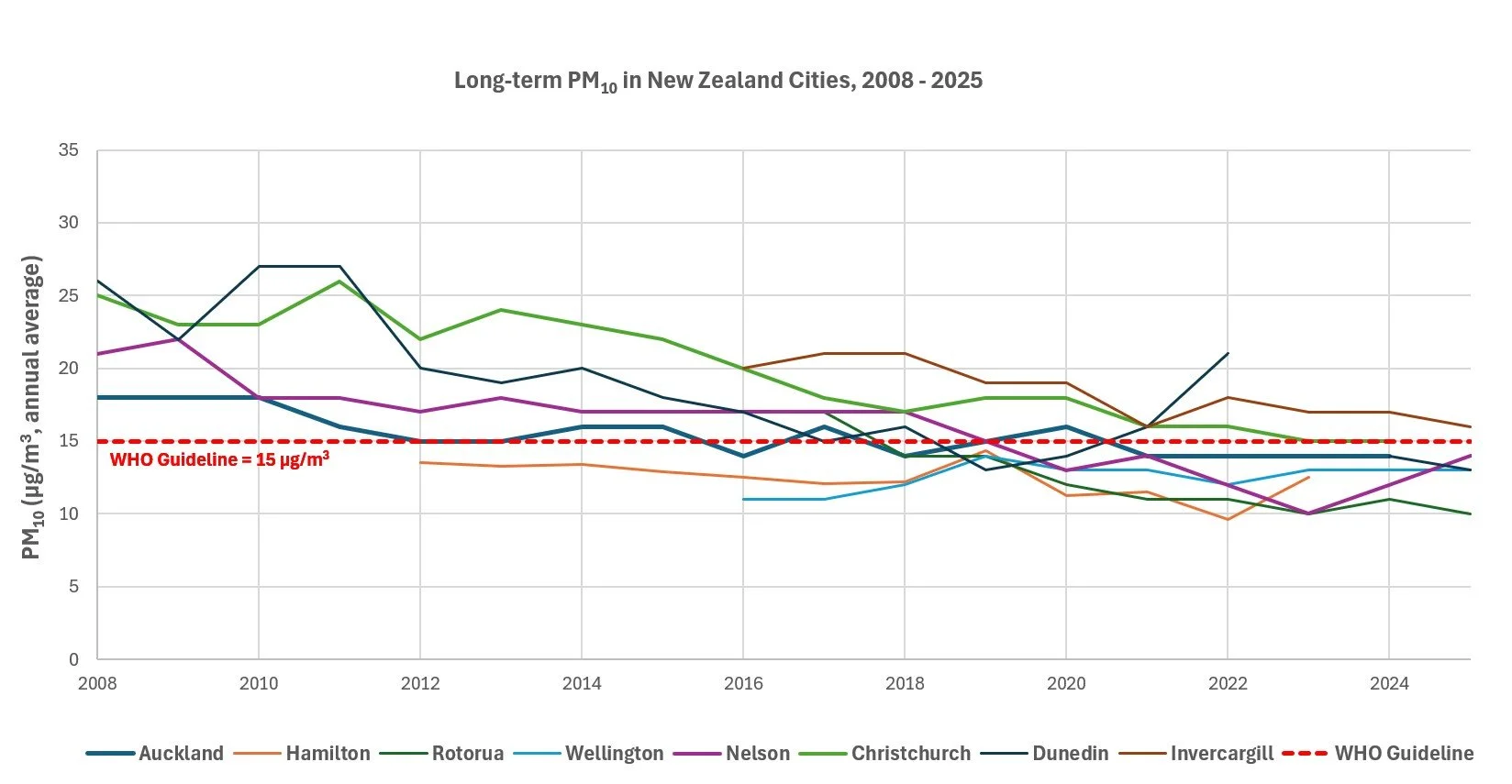
Figure 1: Graph of long-term PM₁₀ levels in NZ cities, 2008 – 2025, showing downward trend. Data compiled from LAWA and Waikato Regional Council.
Unfortunately, despite domestic fire emissions reducing, increasing population and increasing numbers of vehicles on the roads means air pollution is still an issue for NZ. A study we prepared estimated that human-generated air pollution was associated with 3,239 premature deaths in NZ in 2019 (further detail in Note 2 of Appendix below).(2) Motor vehicle emissions alone accounted for around 70 percent of all cases – contributing 2,247 premature deaths per year.
… but they are outdated
WHO updated their global air quality guidelines in 2021 to reflect the considerable body of new scientific evidence, with levels that are significantly tighter to recognise that health impacts occur at concentrations much lower than previously recognised.(4)
While the 2021 WHO guidelines have no legal status in NZ, they are widely accepted by air quality and public health professionals, and the Ministry for the Environment reports against them.(5)
Preliminary modelling we have undertaken estimates that meeting the WHO guidelines for PM₂.₅ and NO₂ in NZ would avoid around 700 premature deaths each year.(3) Reducing air pollution really is beneficial for public health.
RM reform and air quality limits
The NZ Government is replacing the Resource Management Act 1991 (RMA) with two new laws: the Planning Bill and the Natural Environment Bill.
The Natural Environment Bill provides Ministers the power to develop human-health limits for air quality based on an “acceptable standard”, which is defined as the level that would, as a minimum, “prevent significant or irreversible harm to people and communities”.(6)
It is not clear whether the existing national air quality standards will remain or be updated. However, last week the Select Committee reported back to Parliament, revising the Bill to grant Ministers a much broader power to breach these limits.
When is a limit not a limit?
The RMA was not perfect, but it did deliver minimum health protection for all New Zealanders through the setting of national air quality standards that could not be breached. The revised Natural Environment Bill will not.
Clauses 79 and 164A of the revised Natural Environment Bill explicitly allow the Minister to authorise activities that will breach human-health limits if satisfied that its public benefits outweigh the harm to human health. The sheer breadth of this change is shocking – it means the limits cannot be relied on to protect human health.
These types of provisions are called “Henry the 8th clauses” because the Minister has extremely broad discretion to change how the law applies in quite fundamental ways without going back to Parliament to change the law itself.
Under the current Bill, the Minister could conceivably grant exemptions for industry, quarries or mines to release excessive harmful emissions near a community.
We think human health limits should be bottom lines that cannot be breached.
What this PHCC Briefing adds
Revisions to the Natural Environment bill before Parliament have weakened the ability of “human-health” limits to protect human health. There is no ‘bottom line’ for health protection.
This is because the revised bill includes “Henry the 8th” style clauses that mean Ministers can override human-health limits for air quality by authorising activities that will breach them.
Environmental limits, particularly human health limits, need to be bottom lines that cannot be breached.
Implications for policy and practice
The public deserves certainty that their health will be protected when setting national air quality limits for the air we breathe.
Clean air is a universal human right, and air quality limits should provide a minimum of public health protection.
The Natural Environment Bill should be sent back to the Select Committee for further consideration.
Authors details
Lou Wickham, Director & Senior Specialist, Emission Impossible Ltd, Tāmaki Makaurau | Auckland.
Dr Gerda Kuschel, Director & Senior Specialist, Emission Impossible Ltd, Tāmaki Makaurau | Auckland.
Professor Simon Hales, Co-Director, Public Health Communication Centre, and Department of Public Health, Ōtākou Whakaihu Waka, Pōneke | University of Otago, Wellington
Appendix
Note 1
Acute effects are those related to short-term (e.g. daily) exposure, whereas chronic effects are related to long-term (e.g. annual) exposure and represent typically ten times the health burden in costs.
Note 2
Our study also estimated 13,237 hospitalisations, 12,653 cases of childhood asthma and over 1.771 million restricted activity days (which are days when symptoms were sufficient to prevent usual activities, such as work or study) associated with long-term fine particulate (PM₂.₅) and nitrogen dioxide (NO₂).(2)
References
United Nations General Assembly. The human right to a clean, healthy and sustainable environment: resolution adopted by the General Assembly. New York (NY): United Nations; 2022. Report No.: A/RES/76/300.
Metcalfe J, Kuschel G. Public health risks associated with transport emissions in New Zealand. Part 2: Road transport emission trends. Prepared for ESR. Wellington (NZ): ESR; 2023 Mar 10.
Wickham C.L. Using the 2019 updated HAPINZ model in Metcalfe and Kuschel (2023) assessing long-term (annual average) PM₂.₅ and NO₂. Unpublished report.
World Health Organization. WHO global air quality guidelines: particulate matter (PM₂.₅ and PM₁₀), ozone, nitrogen dioxide, sulfur dioxide and carbon monoxide. Geneva (CHE): World Health Organization; 2021.
Ministry for the Environment, Stats NZ. Our air 2024 | Tō tātou hau takiwā. New Zealand's Environmental Reporting Series. Wellington (NZ): Ministry for the Environment; 2024 Oct.
Report of Select Committee. Natural Environment Bill 2025 (234-2). Wellington (NZ): New Zealand Legislation; 2026.